
It all began with an initiative of a versatile individual with a long history of entrepreneurship and creative ideas that turned into actions. Ehud Neiger's name might not be familiar to the public, but he was responsible for some infrastructure projects in Israel over the past few decades, of which we'll mention just two. If you travel the wide roads around Israel and wonder how the historic Ma'atz company transformed—from a department in the Ministry of Transportation struggling to meet schedules and financial forecasts to a government-owned National Roads Company, which has covered the country with highways —you’ll find him there. Neiger was the primary advisor and central figure in the organizational restructuring process. He helped to establish the system of procedures and regulations and institutionalized the operational budget. He was the one who, through significant efforts, convinced a large British company to work in Israel, despite concerns over the Arab boycott imposed at that time on many international companies that established connections with Israel. He also recruited the first engineers for the company to design and oversee the road system that was subsequently planned and constructed.
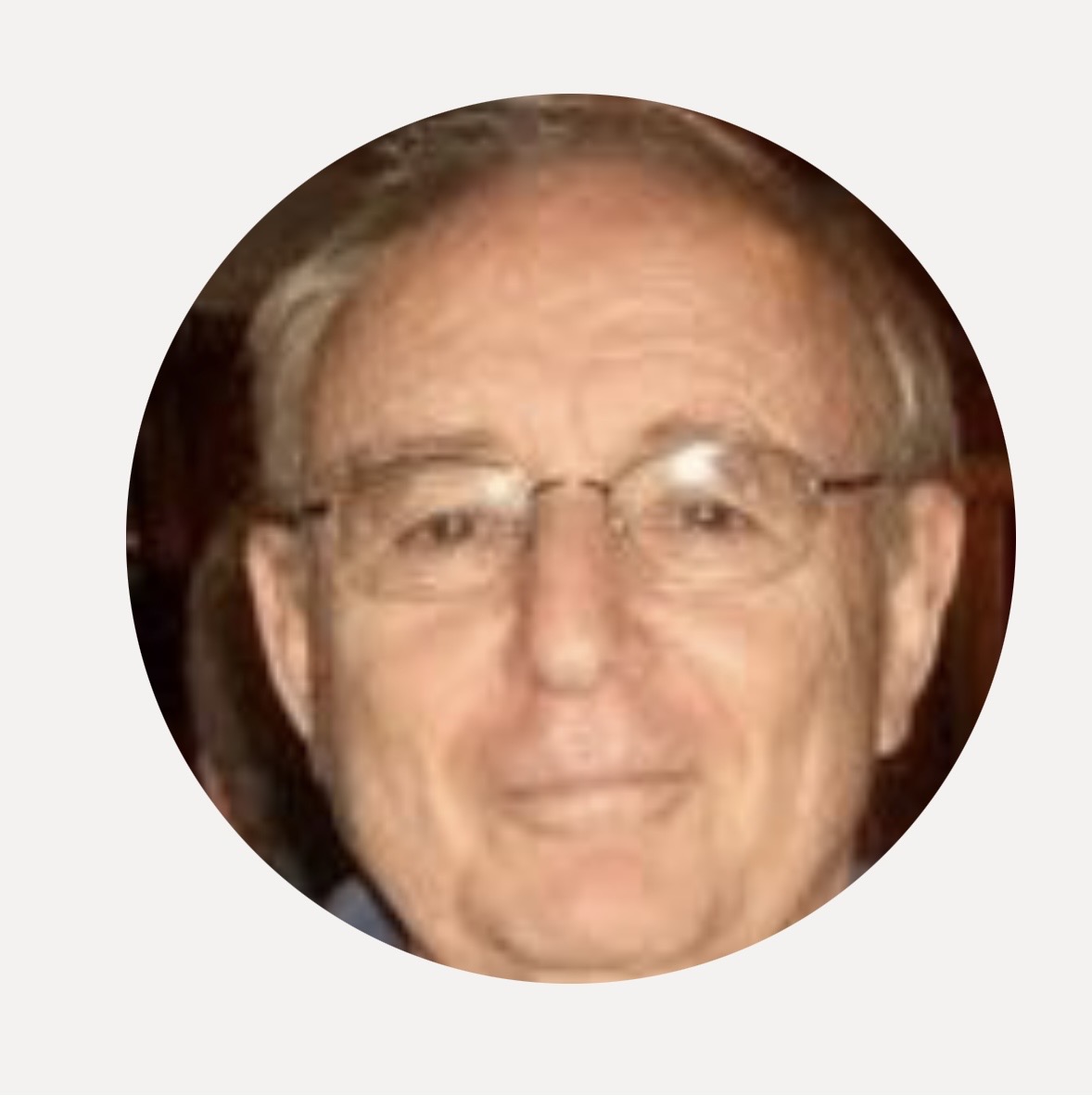
And have you wondered how the mobile phone market in Israel changed? How did it happen that it started with astronomical prices for the service and devices we became addicted to, and ended up more reasonable and cheaper? Again, you’ll find Ehud Neiger behind the scenes. He was the man who established the international consulting group that examined various options to improve the market and recommended Partner as the third cellular operator. Despite debates and objections from various Israeli entities, including government officials, who supported a less efficient company, Neiger succeeded in bringing Partner in, thus opening the competition that shattered the market and drastically reduced prices. The rest is history.
An experienced economist, a visionary strategic consultant, and an analyst who quietly examines complicated situations and seeks solutions, Ehud Neiger meticulously maintains his privacy and tries to "see what others do not perceive," as he puts it, and think big.
We met to discuss a project he initiated over three decades ago, one of many, which he is particularly proud of, even though it was relative small compared to others: "The Institute for Applied/Industrial Mathematics" near Ben-Gurion University in the Negev.
Part A: The Idea
When and how was the idea to establish such an institute born?
Neiger: In the early 1990s, when the gates of the Soviet Union opened, there was a massive wave of Jewish immigration to Israel. It was clear that this was a blessed immigration of a largely educated population. 40% of the immigrants were academics, compared to only 8% in Israel at that time. Among them were tens of thousands of university graduates and graduates of higher technical institutions, who brought with them extensive knowledge, excellent skills, and a broad education in the sciences, as well as considerable practical experience. I thought about how to absorb this wonderful selection of scientists, ensuring they wouldn't only become high school teachers (though this is important) or, as happened to many, be absorbed into blue-collar jobs to make a living. Since I was acting as an entrepreneur and consultant at that time in the Negev, I spoke with many of them who were in the early stages of absorption. The idea came to my mind to establish a research institute for applied mathematics that would provide practical services to Israel's industry and organizations that need mathematical knowledge to develop, such as the Electric Company, Bezeq (the telephone company), computer companies that had begun operating vigorously at that time, and many others. The idea was for the institute to start operating with external funding and, over time, grow and gain a reputation, thus being able to fund itself.
Why specifically mathematics?
Neiger: Mathematics is a critical discipline for the industry in all its forms, and it can assist in fields such as industry and management, databases, algorithms, simulations, and performance research, as well as develop financial models for risk assessment. All of these, among others, enable optimization, data-driven decision-making, and oversight of advanced technologies. This was, as mentioned, the beginning of the widespread use of computers, and I believed that such a boost to Israeli science and economy would benefit all parties involved.
Why was the connection to a university important, and why was Ben-Gurion University in the Negev specifically chosen?
Neiger: It was clear that university sponsorship was necessary for such an institute to ensure a high academic standard and to absorb the scientists into a higher education institution, so they could also train students for advanced degrees, in addition to their research and development work at the institute. I hoped that some of them would also be absorbed into the university in the future as researchers and lecturers. Since there was a concentration of scientists in the south, Ben-Gurion University appeared to be a suitable home that would also achieve an additional goal—a significant contribution to economic development in the southern part of the country.
What were your first steps to promote the idea?
Neiger: I approached the Genesis Foundation, which at that time focused on developing the Negev. I knew them from a previous connection I had with it, and I knew they would be open to ideas they deemed acceptable. I had several proposals, but I thought that this direction would spark special interest and had a chance of being realized. Indeed, I received a quick response from Yechiel Admoni, who was the CEO of the fund at the time, asking me to submit a detailed plan in English within a few days, and even offered payment for it. Interestingly, in the letter he sent me, he did not commit to accepting the plan as it was, and noted that if they accepted only the initial draft, I would receive a reduced payment.
What did the program include?
It was recommended to recruit a group of distinguished immigrant mathematicians, to be led by a small number of 'superstars' in mathematics, who would engage in applied research, both initiated by the institute and invited by relevant companies in the country and international markets. The program detailed the institute's goals, specified the physical and managerial requirements, and included a budget assessment for establishment and ongoing operations, as well as basic marketing principles, which I believed to be a crucial factor in such a project.
The foundation accepted my proposal and expressed willingness to allocate funding for the establishment and to recruit additional stakeholders. Representatives of the Jewish Agency were also enthusiastic about the idea and decided to provide financial support. The university administration, headed by then-President Professor Avishay Braverman, who had international economic experience, also expressed support and a desire to assist in establishing such an institute within its walls.
Part B: Laying the Initial Foundation: A Position Paper for the Institute
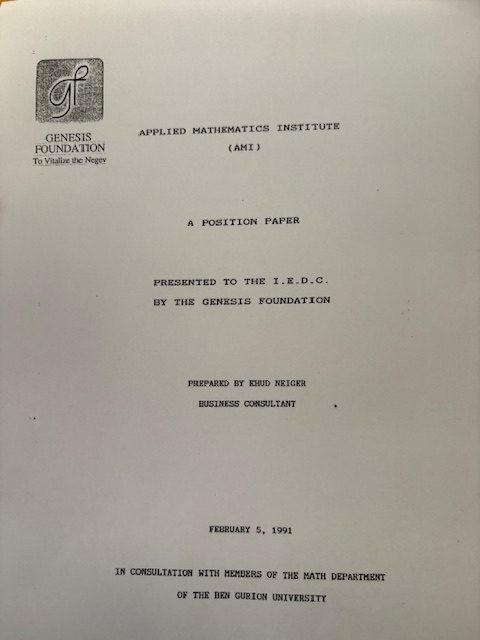 A detailed proposal was submitted on February 5, 1991, to the Genesis Foundation at their request by entrepreneur Ehud Neiger, in English. Below are its main points:
Name: Applied Mathematics Institute (AMI)
Goals
- Significant integration of leading scientists among the immigrants to Israel by providing suitable employment opportunities.
- Promotion of development in the Negev, mainly in the Be'er Sheva-Dimona area.
- Contribution to the economy of the state.
Structure of the Institute:
- The institute will operate near Ben Gurion University in the Negev, but will be independent and manage its budget and research without dependence on the university's budget and research policy.
- Cooperation with the university will include access to resources such as the library and computers, as well as interaction with faculty and students. The scientists will also be able to teach there, alongside their research, and serve as advisors to graduate students. It was recommended to negotiate with the university on implementation methods.
Human Resources:
- The goal is to employ 4-5 "superstars" in the field of mathematics (not necessarily among the immigrants) and 30-40 high-level expert scientists. In the first phase, 2-4 leading scientists and up to 10 mathematicians and experts in related fields will be recruited to create the foundation for the institute. Expansion will be based on work progress and invitations.
- The scientists will be employed under fixed-term contracts, emphasizing their integration into the institute and the long-term productivity of their work.
- Administrative staff and marketing experienced personnel will also be recruited – initially 3-4 people and eventually up to 10.
Facilities:
- It is recommended to locate the institute within the campus or near the university.
- There is a need for space for offices, seminar rooms, and a computer lab, estimated at 1000-1200 square meters.
- In the first phase, a rented building that meets the minimum needs for carrying out work should be identified, while simultaneously promoting plans to establish a dedicated permanent building in the future.
Budget (Estimate):
- Initial investment of $180,000 and in phase two $600,000.
- Annual operating budget of $1.1 million in phase two.
- Salaries for scientists and administrative staff will constitute about 40% of the annual budget in the second year and about 80% in the fourth year.
Marketing:
- The success of the institute will primarily depend on careful selection of high-skilled scientists and secondly, on developing products and services for industry and research institutions in Israel and abroad.
- The institute will operate with a marketing orientation.
- The institute will focus on practical applications of mathematics in broad areas, such as solutions for electrical and electronic systems, conductivity, materials, space sciences, optics, oil exploration, and geological surveys. It will also develop educational software and ensure the translation of teaching materials and research from Russian and English into Hebrew.
- The institute will develop targeted research proposals for various stakeholders in industry, academia, institutes, foundations, etc.
- Creating partnerships with foreign countries, institutes, and private individuals will be critical for funding work, reputation, and credibility.
In Summary: The Applied Mathematics Institute aims to integrate the highest-level scientists among the new immigrants into the Israeli economy, with a special effort to develop the Negev. The plan is to achieve budgetary independence through scientific research and cooperation with industry, through marketing efforts. Initial support will come from public funding and private foundations. According to Nieger's estimates, after two years of practical work, about 40% of expenses will be covered by self-generated income, and in the fourth year, this will reach 80%. With proper management, the Applied Mathematics Institute could significantly contribute to the Israeli economy.
Part C: Establishment of the Institute 1992
After the proposal to establish the institute was submitted, the Genesis Fund forwarded it for review and evaluation to professional entities in Israel and abroad. Everyone supported the idea and provided insights from their experience. They found out that similar institutions operate in universities in the USA and Germany. With the agreement of Ben Gurion University, the journey began to look for a professional director for the institute and to select suitable scientists. At the same time, the localization of physical infrastructure commenced as well.
Mathematician Prof. Avner Friedman, who had established a similar institute at the University of Minnesota, was invited to Israel to assist in selecting the first group of scientists. Together with Prof. Miriam Cohen from the mathematics faculty at Ben Gurion University and other faculty members, several dozen candidates were interviewed, and the first ten scientists deemed suitable for work at the institute were selected. During his visit to Israel, Friedman also met with representatives of the Israeli industry and institutions that appeared to be potential future clients. In an interview conducted about thirty-five years later, he recounted that he had met with managers of companies across the country, asking if they would be willing to receive mathematical consulting for problems they encountered in their work. Everyone responded positively, but when it came to execution, there was, in his words, a gap "between saying and doing." He recommended that the university seek a scientist to visit factories and recruit industrialists on the subject. In other words, he suggested expanding the marketing aspect, as proposed in the initial position paper submitted by Ehud Neiger.
Toward the end of 1991, it was decided to establish the institute as an independent association (NGO) dedicated to research and to register it as a "public institution" authorized to receive donations. It was suggested that the association would later transition into a company.
At that time, an open meeting for the media was held by the Knesset's Immigration and Absorption Committee. MK Yossi Beilin, who was then the chairman of the subcommittee on national projects in absorption, presented the interim conclusions of the committee, which examined employment absorption possibilities for immigrants in the fields of health, industry, and education. (Twelfth Knesset, Third Session, Protocol no. 165, July 31, 1991)
The establishment of the Institute for Applied Mathematics was brought to the committee's attention as part of a discussion on the absorption of immigrant scientists. Representatives from Ben Gurion University and the Genesis Fund participated. Beilin quoted in his remarks the proposal submitted to the Genesis Fund: "[This is] an attempt to utilize the unique human resources coming from the USSR—40% are academics, compared to 8% in Israel, which is astounding, and we can either waste it or make the most of it. The idea was to find employment for four to five stars in the field of mathematics alongside several dozen senior researchers in this area, who would provide services to software companies facing mathematical problems."
Beilin added that the institute would need to rely on personal donations because "if we suggested that the government fund the research, we wouldn't get very far." In response to the question of who is leading this, he added that he had connected the Genesis Fund with a Jewish investor interested in assisting the immigrants and hoped that this would come to fruition. MK Beilin emphasized that the absorption of elite scientific personnel coming from the Soviet Union is vital for us, as it would signal to other immigrants that it is possible. He expressed concern that if leading scientists do not find suitable work, they will not remain in the country and will seek their paths abroad.
In a meeting of the association's Board and guests in the office of the university's president, Prof. Braverman, held on November 7, 1991, Prof. Friedman reported on his visits to eight factories, stating, "the initial impression is that most of the industries we met with could have an interest in ordering work from the mathematics center." He also reported on interviews with 11 job candidates, among whom 10 were deemed suitable, 3 of them with a score of 10. Friedman stated that the success of the center depends on finding a suitable director. Prof. Cohen said that the university would absorb the mathematicians by December 1, 1991, even before the establishment of the center, within the framework of the "Mathematicians' Pool" approved for the faculty, to allow them to start working. They would then transit to the center.
At that meeting, it was decided to change the name of the institute to the "Institute for Industrial Mathematics" (IIM), which they felt better reflected its goals.
Yechiel Admoni reported that the Jewish Agency allocated $200,000 to the association, an amount sufficient to enable immediate work to commence, and that they expected a grant of one million dollars from the Masto Foundation in Switzerland.
The significant investment indeed came from Switzerland, as a result of Prof. Friedman’s efforts, who, at the request of the agency's CEO, met personally with representatives of the foundation in their office in Geneva. Following the meeting, they agreed to allocate this amount to kick-start the project. Dr. Vladimir Gunter from the mathematics faculty reported on his visit to the USA, during which he established contacts with several industries and is now focused on preparing practical proposals for nine projects that the institute could undertake.
At the end of the meeting, it was again decided that the institute (referred to here as the center) would be an independent entity with "its own structural framework, but it would receive or purchase services in various areas from Ben Gurion University." It was also decided to open an independent bank account and issue a tender for an administrative manager, to find a secretary—trilingual office manager, and to rent offices. The start date for work would be in October 1992. (Tuviyahu Archive 1163.02.046). In practice, the institute began operations in July of that year.
At the beginning of the process, Prof. Miriam Cohen from the mathematics faculty at Ben Gurion University led the work, while a search for a permanent director who could dedicate full-time to the issue was conducted. The one selected was Dr. Adir Pridor, a mathematician who was then working at "Rafael". He accepted the invitation and took on the challenge. Pridor suggested that the institute evolve from an association into a company for industrial mathematics, and indeed, this happened in a later stage. In the first months of 1992, preparations for the establishment of the institute were made, a steering committee composed of senior scientists from Israel and the USA was chosen, suitable employees were interviewed and selected, efforts were made to raise additional funds from the Jewish Agency and the Ministry of Science, and offices were located at the university for the institute's activities.
Part D: The Beginning of Scientific Activity
The institute began operating regularly in July 1992. The first semi-annual report submitted in January 1993, summarizing activities from July to December 1992, reflects the initial achievements reached by the institute in a short period, a result of meticulous preparation and organized work according to the original plan.
Summary of the Report:
Main Achievements:
- Establishment of an operational model
- Initiation and development of connections with industries
- Team development
- Preparations for physical infrastructure
Operational Model:
- Comprehensive visits, after thorough prior preparations, by team members to various factories and meetings with managers and senior personnel in the industry.
- Team meetings to present information gathered during these visits and discussions on ways to engage with clients.
- Working group meetings in small, dedicated teams focused on specific issues.
- Individual research work by team members in preparation for working meetings.
- Writing detailed proposals for industrial plants and relevant institutions as a basis for future contracts.
Fifteen working groups were established for defined topics, meeting regularly for discussions, and writing proposals for interested clients.
Factories and Companies Visited by Team Members in the First Half-Year:
- Israel Electric Corporation
- Dead Sea Works Potash Plant
- American Israeli Paper Mills
- Rotem Amfert Negev
- Israel Military Industries
- Elta Electronics
- Ofakim Technological Center
- Center for Mathematical Simulation in Industry
Professional Meetings with Potential Commercial Institutions:
- The Neo-Surgical Department at Beilinson Hospital
- SAGANTEC – Silicon Compiler Software, The Netherlands
Completed proposals were submitted to the Israel Electric Corporation and Dead Sea Works, with one expected to turn into a contract in the near future. About ten additional proposals are in advanced preparation stages and will be sent in the coming weeks.
Team Development
Out of approximately sixty thoroughly examined candidates, twelve were selected in the first stage, including the director. Employment contracts were signed with most of them, making them, for the first time since their immigration, permanent employees in their specialized fields.
An intensive program for learning technological Hebrew, technological English, and text processing on PC, comprising 500 hours, was developed and is being implemented by the technological institute in Be'er Sheva. Additionally, managed conversation meetings led by volunteers from WIZO are held to improve the Hebrew skills of team members.
Due to the wide variety of dilemmas identified during the preparation processes, the scope of individual scientific work by team members significantly increased, requiring intensive efforts. Many hours were dedicated to research in libraries to find previous works and relevant data for solving the discussed problems. Approximately fifty working papers were prepared by team members in draft format and distributed among peers for group discussions. Some preliminary models were run on special computer software developed for this purpose.
The report concludes with the statement that, like any new initiative, the institute faced serious obstacles during its initial operational period, some of which were temporarily resolved, while others are still being addressed. The main difficulties lie in the logistical domain—office dispersion across the campus and the lack of shared space for scientists' work. This continued in the following years until the entire institute moved to an office building in Be'er Sheva, near the university campus.
According to the semi-annual report, not all of the institute's income has been utilized. Of the 640,000 shekels from the Masto Foundation donation and the Jewish Agency's allocation, expenses amounted to only 459,000 shekels.
Part E: A Company is established.
After Dr. Adir Pridor was appointed as a director, he turned the institute into a company. The planned activities continued and expanded, as evidenced by a report he submitted two years later, which aimed at "initiating processes that will lead to the institute's permanent status."
The report reiterated the institute's original goals and added the need to achieve economic viability by stabilizing public funding at least during its first four years of work. It emphasized the need to increase scientists' salaries, so they do not move to academic institutions or other organizations that offer much higher compensation. (Tuviyahu Archive 1146.01.074) Indeed, the institute continued its work accordingly. Prof. Michael Lin of Ben Gurion University's Mathematics Faculty remembers that, in later years, some of its scientists were integrated into universities or other workplaces, and that many industries established private scientific units, which caused a reduction in their orders.
To sum up:
This article wishes to honor this unique project that was established following the large immigration from the former USSR, to provide a professional absorption solution for a group of leading mathematicians who came to the country during this blessed immigration. We find it appropriate to mention here the person who initiated it, Mr. Ehud Neiger, and the involvement of many bodies that took it upon themselves to make the idea come true in a short time. Ben-Gurion University, led by Prof. Avishai Braverman, which embraced the institute and accompanied it, especially the Faculty of Mathematics and Prof. Miriam Cohen who was in charge of its first steps; the first director who developed the institute, Prof. Adir Pridor; Prof. Avner Friedman who came from abroad to interview and select the first group of scientists and industries; various foundations, led by the Genesis Fund, under the leadership of CEO Yichiel Admoni, who committed to funding the institute; the Swiss Masto Fund; the Jewish Agency; the Ministries of Absorption and Science in the Israeli government; and of course – the scientists who faced the huge challenge of continuing to engage in their profession while acquiring two essential languages for success – Hebrew and English, and while settling their families in their new country; as well as the industries and companies that embraced the idea of using mathematical models to improve their work, providing jobs for the institute in its early days and indeed deriving significant benefits from it.
All of these, among others, contributed to the success of the Institute for Applied/Industrial Mathematics in the Negev during a historic period of blessed immigration and economic and social growth.
Sources
- Ehud Neiger, interview, October 2025
- Prof. Michael Lin, telephone interview, November 2025
- Prof. Avner Friedman, telephone interview, December 2025
- Genesis Foundation Archive deposited in the Negev Archive in the name of David Tuviyahu, in Aran Library, Ben-Gurion University of the Negev
Special thanks to Ms. Mira Vazana, in charge of the archive, for her help
- Ehud Neiger, private archive
- Materials from the press and the Internet
Photographs: Ehud Neiger, private archive
March 2026